

The Tucker 48: Innovation That Detroit Couldn’t Handle
In 1948, while Ford, GM, and Chrysler were still building warmed-over pre-war designs with separate fenders and running boards, a small factory in Chicago rolled out a car that looked like it had landed from 1975.
It had sleek, aerodynamic lines with headlights embedded in the fenders, doors that curved into the roof, a rear engine, disc brakes, a padded dashboard, pop-out safety glass, and a “Cyclops eye” center headlight that turned with the wheels. Most shocking of all: it promised seat belts, a crash-proof passenger compartment, and fuel injection—things American buyers wouldn’t see in mainstream cars until the 1970s and 1980s.
This was the Tucker 48, nicknamed “The Torpedo” and later called the “Car of Tomorrow—Today.” Only 51 were ever built. Today, every surviving example is priceless. Here’s the story of the most revolutionary American car you’ve probably never driven.
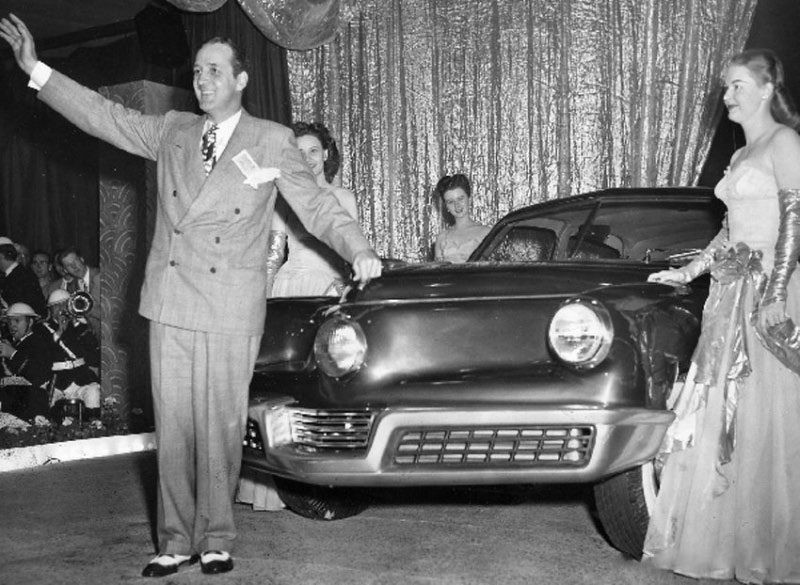
Image Credit: Photo courtesy of the National Automotive Heritage Collection, via motorcities.org
The Man Behind the Dream
Preston Tucker was a born promoter—part P.T. Barnum, part Elon Musk. During World War II he’d designed a futuristic combat car and a machine-gun turret that was used on bombers. In 1946, with peace restored and Americans hungry for new cars after 15 years of Depression and war shortages, Tucker saw his opening.
His pitch was audacious: he would leapfrog the Big Three with a completely new automobile built around safety and innovation. He raised money by selling dealership franchises and accessories before a single car existed (perfectly legal at the time). He leased the largest factory in the world—the 475-acre Dodge Chicago plant that built B-29 engines—and hired top designers like Alex Tremulis (who sketched the final shape in just six days).
The result looked like nothing else on the road.
The Technology That Scared Detroit
The Tucker 48 wasn’t just pretty; it was packed with ideas decades ahead of its time:
- Perimeter frame with integrated roll protection and a crumple zone (the “Safety Chamber” where passengers could supposedly dive to the floor in a crash)
- Padded dashboard and recessed instruments
- Pop-out windshield (designed to eject on impact)
- Seat belts offered as an option (GM mocked them as “unnecessary”)
- Independent suspension on all four corners
- Disc brakes (when most cars still used drums)
- Rear-engine, rear-wheel-drive layout with a modified helicopter engine
- Hydraulic torque converters instead of a traditional transmission (no shifting required)
- That famous directional center headlight (“Cyclops eye”)
The press went wild. In June 1947, 3,000 VIPs and reporters watched the prototype unveiled to the blaring soundtrack of 200 men pounding on anvils. Tucker promised the car would do 0-60 in 10 seconds, get 35 mpg, and cost under $2,450—roughly the price of a loaded Cadillac.
The Conspiracy
The Big Three took notice—and panic set in.
Tucker needed steel, which was still rationed after the war. He needed more capital. And most of all, he needed the SEC and the public to believe in him.
What happened next has been debated for 75 years. The official story: Tucker over-promised, under-delivered, and ran out of money. The darker version (backed by mountains of circumstantial evidence): Detroit, with help from politicians and regulators, orchestrated a smear campaign and death by a thousand regulatory cuts.
The Securities and Exchange Commission launched a full investigation into Tucker’s stock offering. The press suddenly turned hostile, accusing Tucker of fraud. A Senate committee grilled him publicly. Meanwhile, the Big Three sat on huge cash reserves and dealer networks that Tucker could never match.
In 1949, the Tucker Corporation was forced into bankruptcy. Preston Tucker and his executives were indicted for mail fraud and conspiracy. After a four-month trial, they were acquitted on all 31 counts—but the company was already dead. The factory was sold for pennies on the dollar to Chrysler.
The 51 Cars That Survived
Only 51 Tuckers were completed (50 production cars plus the prototype “Tin Goose”). Nearly all still exist today, lovingly preserved by collectors. The most famous is #1038, featured in Francis Ford Coppola’s 1988 film Tucker: The Man and His Dream, starring Jeff Bridges.
At auction, Tuckers now trade for $2–3 million each.
Legacy
Preston Tucker lost everything—his company, his savings, his reputation. He died of lung cancer in 1956 at age 53, still trying to launch another car company.
Yet almost every “revolutionary” safety feature he pioneered became standard decades later:
- Padded dashboards (1960s)
- Seat belts (1960s–1980s)
- Pop-out windshields evolved into laminated safety glass
- Directional headlights (adopted in Europe in the 1960s, finally legal in the U.S. in 2022)
- Rear-engine layout (Corvair, Porsche, VW Beetle, modern EVs)
The Tucker 48 wasn’t just a car. It was a warning shot across Detroit’s bow: innovate or die. The Big Three chose to crush the threat instead of rising to it. It would take Japanese and European brands—and later Tesla—to finally force that change.
Next time you buckle your seat belt or enjoy the smooth ride of four-wheel independent suspension, thank Preston Tucker.
He was right. They just wouldn’t let him prove it.
What is your reaction?